FRP & Fiberglass Shredder Machine for Waste Recycling
FRP sheets, panels, rods and rejects — shredded at 300–500 kg/hr on a frp shredder built for the most abrasive plastic waste there is. Hardened, re-sharpenable blades, 24-hour continuous duty, made in Mumbai since 1985.
The FRP Waste Challenge — Why Fiberglass Can’t Go to Landfill
Fibre Reinforced Plastic is everywhere Indian industry builds things — sheets and corrugated roofing, decorative panels, tanks and pipes, boat hulls, automotive and railway components, cable trays, rods and gratings. Every fabricator generates trim and offcuts; every product eventually comes back as scrap. And unlike PET or PP, FRP cannot simply be remelted: it is a thermoset composite, glass fibre locked in cured resin. Heat it and it chars; it never flows again.
That is why FRP piles up. Landfilling is the worst answer — FRP waste is hazardous in landfills, where it persists indefinitely and contaminates soil, air and water, and disposal norms keep tightening for bulky industrial waste. Burning it in the open releases toxic fumes. The workable route is mechanical: shred the material into small pieces, grind it further where needed, and feed it into established outlets — shredded and ground FRP is used as an additive in brick making and cement manufacturing, and as filler in new composite and construction products. The bottleneck is the machine: FRP is hard, abrasive and tough on blades, and a shredder not built for it will not last.
The Right Shredding Approach for FRP & Fiberglass
Our standard recommendation is the S3-600 Single Shaft FRP Waste Shredder. Its rotor turns at a slow 80 rpm with high torque — the right way to bite through rigid, fibrous composite without shock-loading the drive — and its blades are hardened tool steel specifically because glass fibre abrades ordinary cutting edges fast. The 600 × 1000 mm side-feeding hopper takes FRP sheets, decorative panels, boards, rods and molded products; a 22 kW three-phase motor drives the machine through a heavy-walled cutting chamber; and it is built for 24-hour continuous operation at 300–500 kg/hr depending on material density. Construction is all metal — no plastic parts.
Where the output needs to be finer than coarse shred — cement and brick applications usually want a ground product — a second-stage FRP grinder (RE-series) reduces the shredded pieces further. For very heavy sections and high volumes, Raj Electricals also manufactures heavy-duty dual shaft FRP waste shredder machines; tell us your material and we will recommend the right configuration. Because FRP grinding produces fine, irritant glass-fibre dust, plan dust extraction and operator PPE into the installation from day one — we advise on layout during commissioning.
FRP Shredding Process — From Panel to Filler
- Collection & segregation FRP offcuts, rejects and end-of-life products are separated from metal fasteners and frames
- Pre-cutting oversized pieces Large sheets and tanks are cut down to fit the 600 × 1000 mm side-feeding hopper
- Primary shredding at 80 rpm The S3-600’s hardened blades reduce panels and rods to coarse shred at 300–500 kg/hr
- Secondary grinding An FRP grinder reduces shred to the fine fraction cement and brick applications need
- Dust capture Glass-fibre dust is extracted at source; operators work with PPE
- Output to reuse Ground FRP goes out as additive for brick making, cement manufacturing and composite filler
Recommended Machines for FRP Waste Shredding
The S3-600 single shaft is the proven workhorse; dual shaft and grinder options round out the line. Full spec tables live on each machine page.
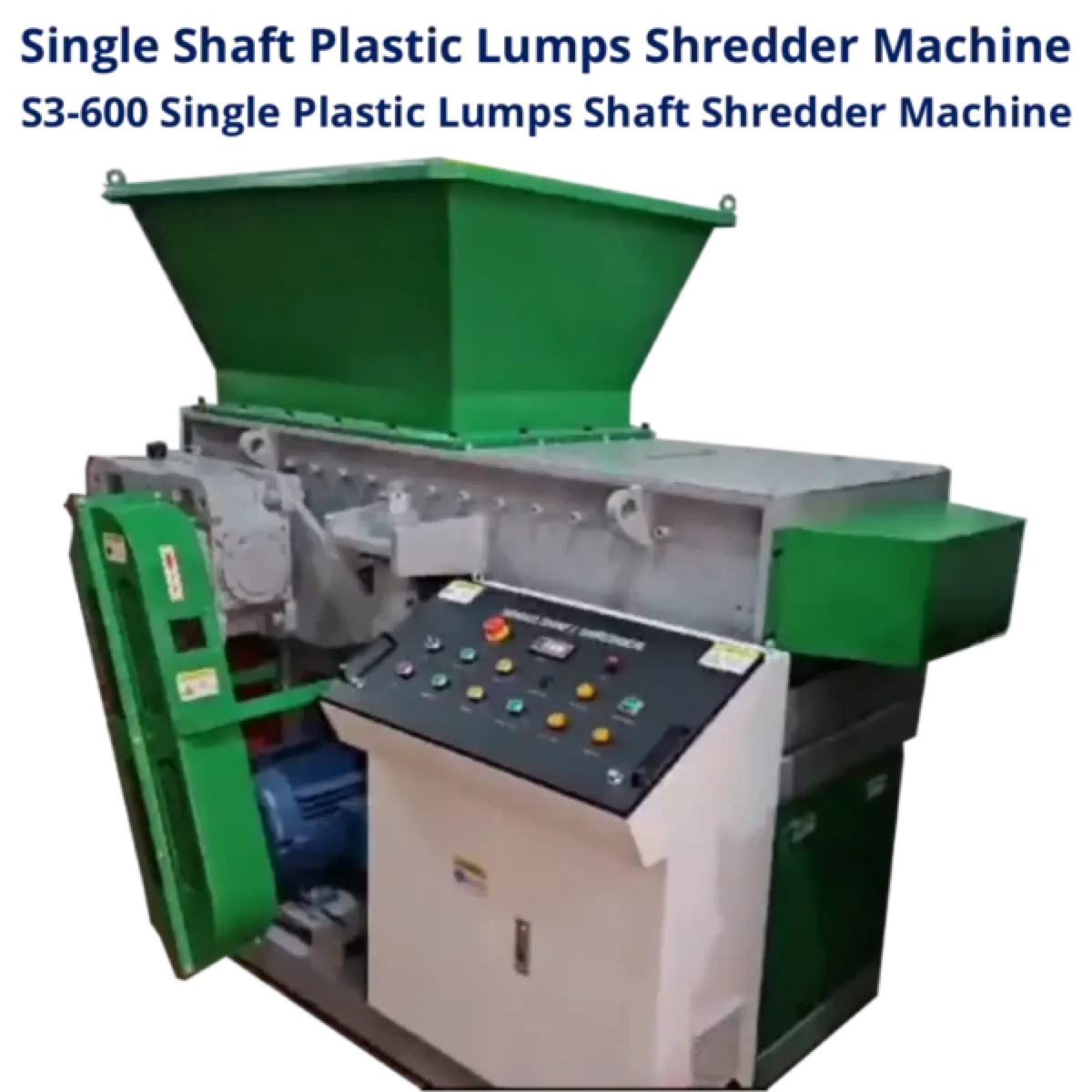
S3-600 Single Shaft Shredder
Slow-speed single shaft · 24-hr continuous duty · FRP sections
- Capacity: 300–500 kg/hr (by material density)
- Drive: 22 kW, 415 V, 3-phase
- Blades: 26 rotary + 2 fixed, hardened
- Feed: 600 × 1000 mm side hopper
Best for: FRP sheets, decorative panels, boards, rods and molded products — the standard FRP solution.
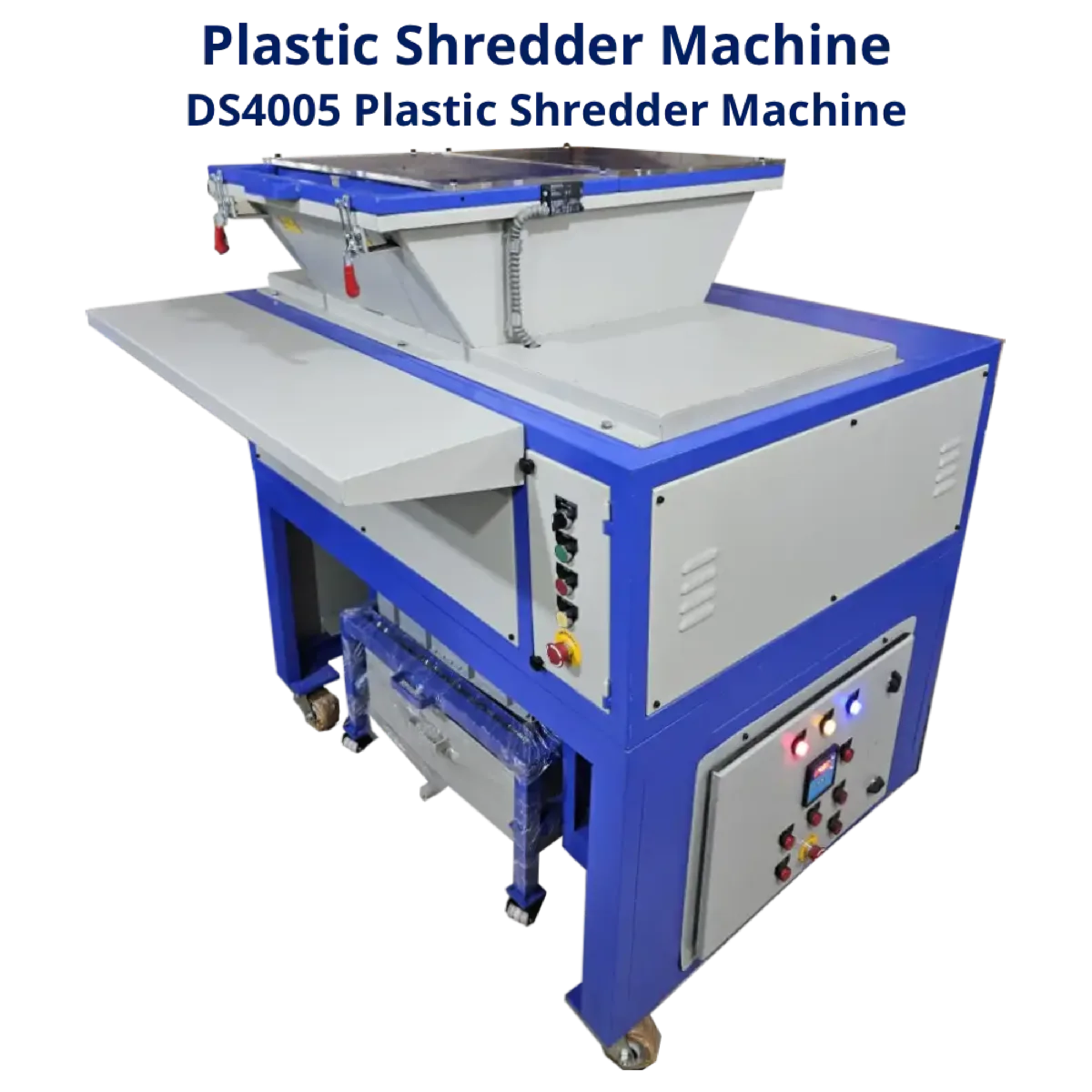
Dual Shaft Shredder Range
Heavy-duty twin shaft · multiple models · thick FRP sections
- Counter-rotating shafts with interlocked blades
- Built for thick, heavy FRP sections
- Model range by output requirement
- Contact us for detailed specifications
Best for: heavy FRP products and higher-torque duty beyond the single shaft’s range.
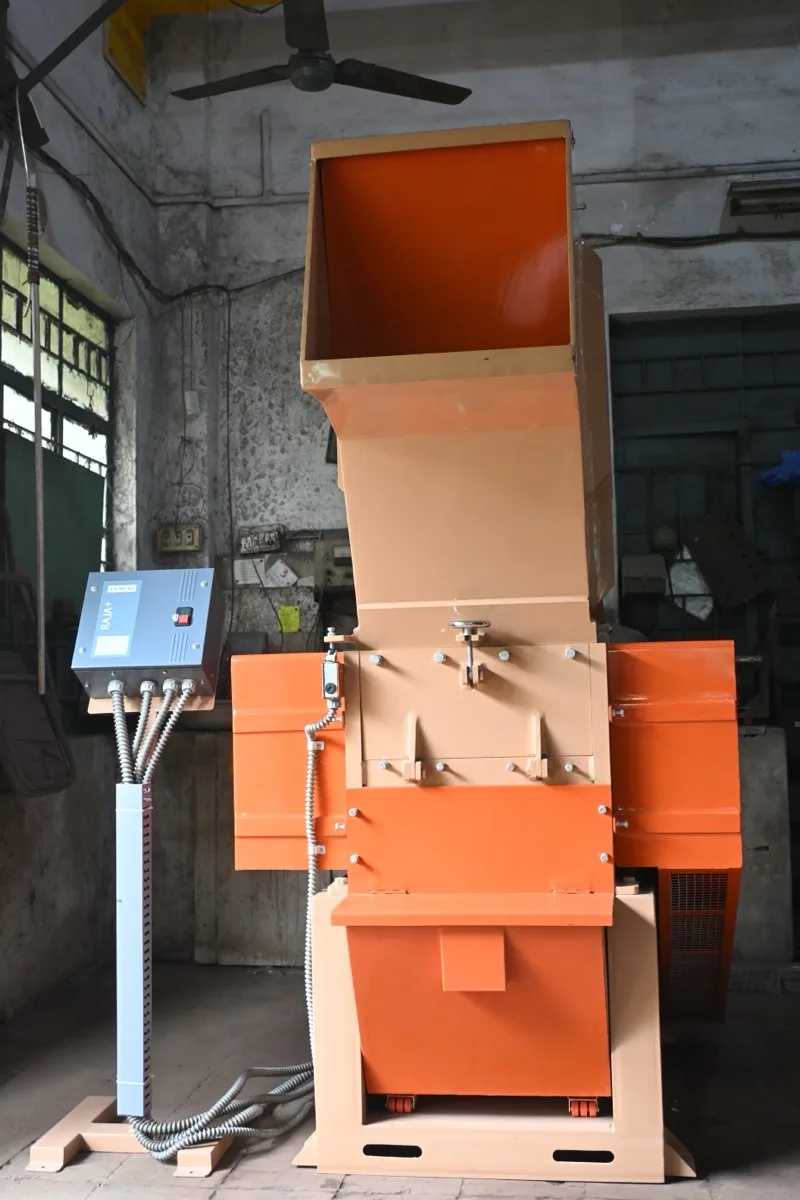
Plastic Grinder — RE12 / RE20
Secondary FRP grinding · fine output fraction
- Grinds shredded FRP sheets and scrap
- Output used in brick making & cement manufacturing
- Durable, user-friendly RE-series build
- Contact us for detailed specifications
Best for: producing the fine ground fraction that cement and brick buyers take.
Technical Specifications Comparison
| Specification | S3-600 Single Shaft FRP Shredder | Dual Shaft FRP Shredder | FRP Scrap Grinder (RE12/RE20) |
|---|---|---|---|
| Role | Primary shredding — standard choice | Primary shredding — heavy sections | Secondary grinding to fine fraction |
| Drive motor | 22 kW, 415 V, 50 Hz, 3-phase | Contact us for detailed specifications | Contact us for detailed specifications |
| Capacity | 300–500 kg/hr (by material density) | By model — share your requirement | By model — share your requirement |
| Cutting system | Slow 80 rpm rotor; 26 rotary + 2 fixed hardened blades | Twin counter-rotating shafts, interlocked blades | Blade-and-mesh grinding chamber |
| Feed | 600 × 1000 mm side-feeding hopper | Top feed for bulky products | Pre-shredded FRP pieces |
| Chamber | 650 × 600 mm, heavy-plate walls | Heavy-duty welded construction | RE-series construction |
| Duty cycle | Continuous 24-hour operation | Heavy-duty continuous | Shift operation |
| Get Quote → | Get Quote → | Get Quote → |
Not sure how to handle your FRP waste?
Sheet offcuts, tank rejects or end-of-life products — describe your FRP waste and volumes, and our technical team will recommend single shaft, dual shaft or a shred-and-grind line, free.
Why Choose Raj Electricals
One of the few Indian manufacturers with a dedicated FRP shredding line — single shaft, dual shaft and grinders, all built and serviced from Mumbai.






Frequently Asked Questions
Why can’t FRP be recycled like ordinary plastic?
FRP is a thermoset composite: glass fibres locked inside resin that cured through an irreversible chemical reaction. Thermoplastics like PET or PP soften when heated, so they can be remelted and remolded; cured FRP resin does not soften — it chars and breaks down. That rules out the melt-recycling route entirely. What works is mechanical size reduction: shredding and grinding FRP into fractions that have value as filler and additive material in other industries.
Who actually buys shredded FRP — is there a real outlet?
The established outlets in India are brick making and cement manufacturing, where ground FRP is used as an additive, plus filler applications in construction boards and new composite products. Cement plants also co-process suitable shredded industrial waste as alternative fuel and raw material. The common requirement across all of them is size: nobody takes whole panels. Shredding — and usually a grinding stage after it — is what converts an FRP disposal liability into a material someone will collect.
Why is dumping FRP waste such a problem?
Because it never goes away. FRP in landfills is hazardous to the environment — it persists indefinitely and contaminates soil, air and water, which is why disposal norms for bulky industrial waste keep tightening and why open burning (which releases toxic styrene-laden fumes) is prohibited. For manufacturers, unprocessed FRP scrap also eats yard space and invites compliance trouble. Shredding for reuse as filler is currently the most practical, defensible disposal route available in India.
FRP is abrasive — how long do blades last?
Glass fibre is the toughest routine duty a shredder blade sees, which is why the S3-600’s blades are hardened tool steel and why the machine cuts at a slow 80 rpm — less rubbing, less wear, more clean cutting. Blades are removable and designed for periodic resharpening rather than throwaway replacement; the interval depends on your running hours and the glass content of your material. We supply spare blade sets and resharpening support from our Mumbai works, so blade maintenance is a scheduled routine, not a crisis.
What size FRP pieces can I feed, and what about big sheets and tanks?
The S3-600 accepts material through a 600 × 1000 mm side-feeding hopper — sheets, panels, boards, rods and molded products within that envelope feed directly. Larger items like full-size roofing sheets or tank sections are pre-cut with a saw or cutter to hopper size first. If your waste is dominated by very heavy, thick sections, ask us about the dual shaft FRP shredder instead — that is exactly the duty it is built for. See the S3-600 Single Shaft Shredder page for full dimensions.
How do you manage fiberglass dust during shredding and grinding?
Treat FRP dust seriously — fine glass-fibre dust is a skin, eye and respiratory irritant. The slow-speed primary shredding stage generates relatively little airborne dust; the fine grinding stage generates more and needs extraction at source, good ventilation, and operators in masks and goggles. Plan the dust collection point when you lay out the machine area, not after. We advise on installation layout as part of commissioning every FRP line we supply.
What does an FRP shredder machine cost in India?
Every machine is quoted to the job. What moves the number is capacity, throat size, motor rating, MS or SS construction and the automation you add — a blower, a conveyor, a control panel. Our guide to what drives machine cost walks through each of those; send us your material and daily volume and we will size the machine and quote it, usually the same day.
Can I trial the shredder with my own FRP waste first?
Yes — and with FRP we insist on it, because resin systems, glass content and laminate thickness vary so much between fabricators. Bring representative samples (your thickest laminate included) to our works at Andheri East, Mumbai, and we will run them so you can verify throughput and output size on your actual material. Contact us to book a trial; outstation and export buyers can request a recorded video trial.
Get a Free Quote for FRP Waste Shredding Machines
Describe your FRP waste — sheet, panel, rod or molded product, with rough monthly volume — and our technical team responds with a machine recommendation and firm pricing, usually within one working day.
102/103/104, Madhu Industrial Estate, Old Nagardas Road, Mogra Lane, Andheri East, Mumbai – 400069
Mon–Sat, 9:00 AM – 7:00 PM
Related Solutions
Plastic Lumps & Blocks Shredding
The same S3-600 single shaft platform, configured for purge lumps and molding blocks.
Learn more →
Automobile Plastic Parts Shredder
Bumpers, dashboards and FRP body components from auto plants and dismantlers.
Learn more →
ABS Plastic Shredding
Another tough engineering plastic — shredded and ground for recovery, unlike thermoset FRP.
Learn more →