Plastic Shredder Buying Guide: Which Machine Should You Buy?
Four questions decide the right machine: what material, in what form, at what throughput, to what output size. Answer them in order and the choice usually makes itself. This guide walks you through each step — with the same decision tables our own technical team uses.
The four-step decision flow
- What material? PET, HDPE, PP, PVC, FRP, film, thermocol…
- What form? Bottles, film, lumps, pipes, mixed scrap
- What throughput? kg per hour you must actually process
- Match the machine Shredder, grinder, or both in line
Step 1 — What material are you processing?
Material decides blade type, motor load and what the shredded output is worth. Soft polyolefins like LDPE film tear differently from glass-filled nylon or FRP, which blunt blades fast. Start by identifying your dominant material — if your stream is mixed, plan around the toughest component, not the easiest.
One honest exception up front: thermocol/EPS is not shredded with blades like other plastics — it needs a purpose-built thermocol grinder. And heavily contaminated post-consumer waste should be pre-sorted before any machine touches it.
Material → machine matrix
Find your material in the left column. Capacities are from our standard specification sheets; actual output depends on material density and feed rate.
| Your material | Recommended machine | Capacity (kg/hr) | Why this machine |
|---|---|---|---|
| PET bottles (up to 1 L) | RE12CB Grinder with Blower | 40–50 | Semi-automatic crushing with blower discharge; built for bottle volumes |
| Plastic bottles, jars (larger/mixed) | RE16 Plastic Grinder | 150–250 | 16″×16″ throat takes jars and containers up to 10 litres |
| HDPE / LDPE bottles & containers | RE Series CB Grinders with Blower (RE8CB–RE40CB) | 20 to 700 | Seven sizes; cyclone blower conveys regrind straight into collection bags |
| Moulding scrap, runners, rejects | Plastic Grinder Machine (RE8–RE40) | 35–1,200 | Uniform regrind through a customisable mesh, ready for reuse |
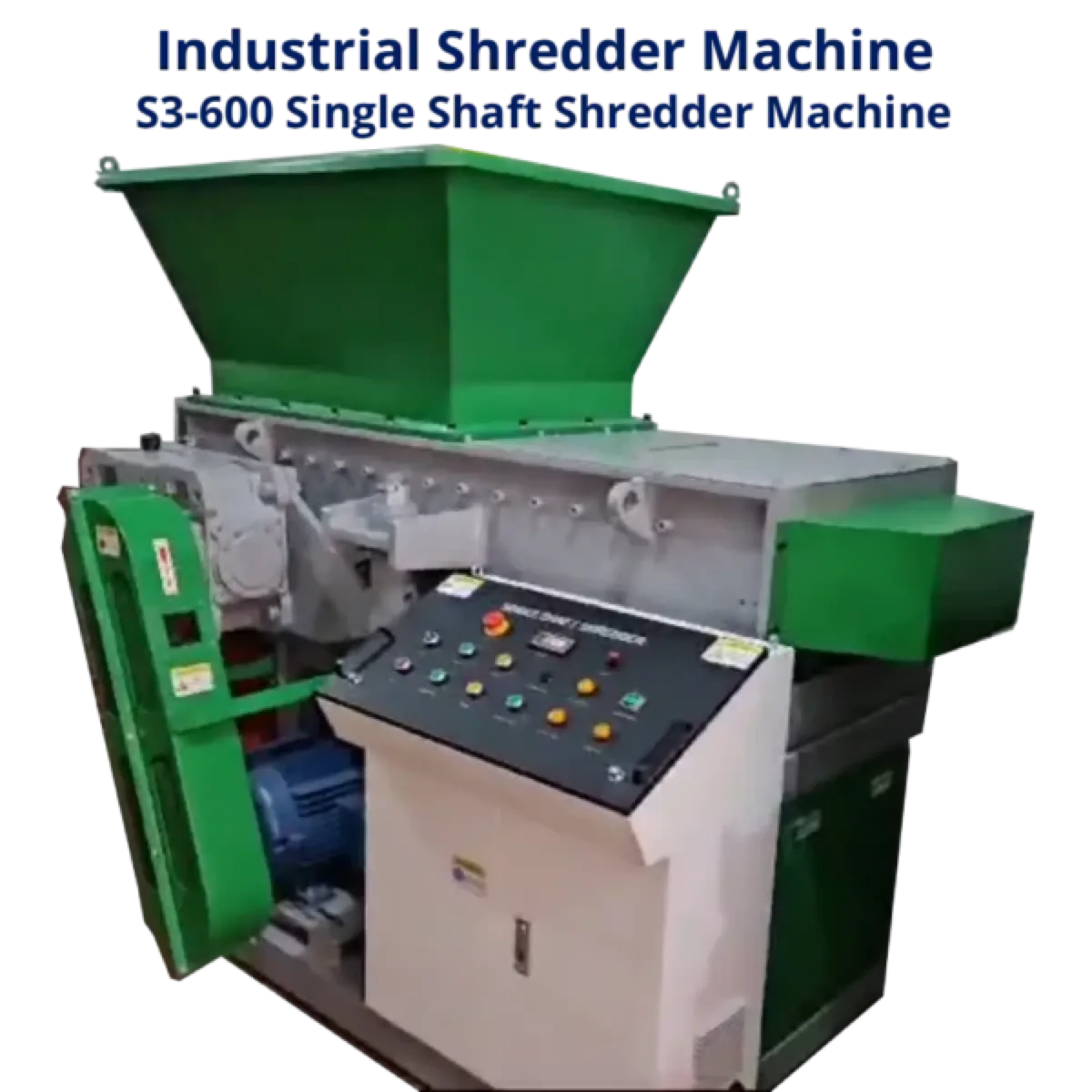
| Plastic lumps, purgings, blocks | S3-600 Single Shaft Shredder | 300–500 | Single rotor with 26 hardened blades handles thick, tough lumps |
| FRP / fibreglass waste | S3-600 Single Shaft Shredder | 300–500 | Hardened blades and a heavy-plate chamber for abrasive FRP |
| Mixed plastic waste, drums, crates | Dual-Shaft Shredder | 200–250 | Counter-rotating shafts grip bulky and irregular items |
| General plastic scrap (high volume) | RE20 Plastic Grinder (20″) | 200 | 20″×20″ throat, 15 HP — the workhorse for plant scrap |
| Laminates, lamitubes, pouches | Laminate Shredder | Per spec | Built for multi-layer packaging waste |
| Cement bags / PP woven sacks | DS5007 Dual-Shaft Shredder | Per spec | Dual shaft action prevents woven bags wrapping the rotor |
| Non-woven bags & fabric | DS5007 Dual-Shaft Shredder (non-woven config) | Per spec | Dual shaft shredder configured for PP non-wovens |
| Thermocol / EPS | RE12CB Grinder with Blower (EPS route) | Per spec | Foam needs a grinder designed for EPS, not a blade shredder |
Step 2 — What form is the waste in?
Form matters as much as material. The same HDPE arrives as bottles, drums or purged lumps — and each needs a different cutting action:
- Bottles, containers, moulding scrap → a grinder/granulator. Thin walls cut cleanly through a screen into uniform regrind.
- Thick lumps, purgings, pipes, FRP sheets → a single shaft shredder first. Slow rotor, high torque, no jamming on solid sections.
- Bulky, irregular or mixed items (drums, crates, bags, film bales) → a dual shaft shredder. The counter-rotating blades pull material in instead of bouncing it.
- Film, woven sacks, non-wovens → dual shaft, configured so flexible material cannot wrap the shafts.
Step 3 — What throughput do you need?
Work from your real waste generation: kilograms per day ÷ planned running hours. Then add 25–30% headroom — machines should not run at their ceiling all shift. Buying one size larger is almost always cheaper than replacing an undersized machine in year two.
| Throughput needed | Machines to consider |
|---|---|
| Up to 50 kg/hr | RE8 grinder · RE12CB Grinder with Blower |
| 60–250 kg/hr | RE12–RE16 grinders · RE16 Plastic Grinder |
| 250–600 kg/hr | RE20 Plastic Grinder · RE25 grinder · S3-600 single shaft |
| 600 kg/hr and above | RE30 (600–800 kg/hr) and RE40 (1,000–1,200 kg/hr) grinders · custom configurations — talk to us |
Shredder vs grinder — which do you actually need?
The two machines do different jobs. A shredder is primary size reduction — it makes big things small. A grinder/granulator is secondary — it makes small things uniform, sized by the mesh you fit (1–30 mm or more, customised).
| Shredder | Grinder / Granulator | |
|---|---|---|
| Job | Primary reduction of bulky waste | Uniform regrind for reuse or sale |
| Output | Uneven shred (strips/chunks) | Even granules through a mesh |
| Handles | Lumps, drums, crates, FRP, mixed waste | Bottles, runners, rejects, pre-shredded material |
| Speed/torque | Low speed, high torque | Higher speed rotor with fixed + rotating blades |
| Buy it when | Waste is too big or tough to grind directly | You want regrind that goes straight back into production |
Many recycling lines need both: a shredder to break down lumps or bales, feeding a grinder that produces saleable regrind. If your waste is already small and clean — moulding rejects, runners, bottles — a grinder alone is usually enough.
Single shaft vs dual shaft shredder
| Single shaft (S3-600) | Dual shaft (DS series) | |
|---|---|---|
| Best for | Thick, hard, dense waste — lumps, purgings, FRP, pipes, wood | Bulky, mixed, flexible waste — drums, crates, bags, film |
| Cutting action | One rotor (26 blades) against 2 fixed blades | Two counter-rotating shafts with interlocking blades |
| Output size | More controlled; suits onward grinding | Uneven shred; sized by blade width |
| Feeding | Side hopper (600×1000 mm on S3-600) | Top feeding; gravity pulls material into the shafts |
| Typical capacity | 300–500 kg/hr | By model and material — see the dual shaft range |
| Start here if | Your problem is toughness | Your problem is bulk and variety |
Still between two machines? That is normal — the deciding factor is usually a trial. Bring a sack of your actual waste to our Andheri East works and watch both run.
Not sure which machine fits your material?
Talk to our technical team for a free recommendation based on your material, volume and output size — and a trial with your own waste.
Selection FAQs
What is the difference between a plastic shredder and a plastic grinder?
A shredder does primary size reduction: low-speed, high-torque shafts tear bulky or tough waste into uneven strips and chunks. A grinder (granulator) does secondary reduction: a bladed rotor cuts material against fixed blades until it passes through a mesh, giving uniform granules sized 1–30 mm or more. If your end goal is regrind you can reuse or sell, the grinder produces it; the shredder exists to make material small enough to grind. See our grinders & granulators range for mesh and capacity options.
Do I need both a shredder and a grinder?
Only if your input is too big or too tough to grind directly. Plastic lumps, purgings, FRP sheets, drums and bales need a shredder first; the shredded output then feeds a grinder for uniform regrind. But if your waste is already small — bottles, moulding runners, thin-wall rejects — a single grinder of the right throat size does the whole job. Plenty of our customers run one RE-series grinder and nothing else.
How do I calculate the capacity I need?
Take your real waste generation in kg per day and divide by the hours you will actually run the machine. A unit producing 800 kg of scrap daily over an 8-hour shift needs 100 kg/hr — plus 25–30% headroom, so a 125–150 kg/hr machine. Remember that rated capacity varies with material density and feed rate: 125 kg/hr of dense lumps is not the same duty as 125 kg/hr of film. When in doubt, size up.
Can I test the machine with my own material before buying?
Yes — we encourage it. Bring your actual waste to our works at Andheri East, Mumbai, and we will run it through the recommended machine in front of you. You see the true throughput, the output size, and how the machine behaves with your specific material. No brochure or video replaces that. Contact us to schedule a trial.
How much does a plastic shredder machine cost?
Every machine is quoted to the job. What moves the number is capacity, throat size, motor rating, MS or SS construction and the automation you add — a blower, a conveyor, a control panel. Our guide to what drives machine cost walks through each of those; send us your material and daily volume and we will size the machine and quote it, usually the same day.
Get a Free Machine Recommendation
Tell us your material, its form, and your monthly volume. Our technical team will recommend a machine, share full specifications and indicative pricing, and invite you for a trial.
Phone: +91 98700 12462
WhatsApp: Chat with our team
Email: rajelectricalsmumbai@gmail.com
Hours: Mon–Sat, 9:00 AM – 7:00 PM