Shredding Plastic for Recycling: How Shredding and Grinding Work Together
Shredding of plastic waste and plastic grinding are two different jobs, done by two different machines. A shredder breaks bulky, thick or tangled waste into coarse pieces. A grinder, which buyers also call a granulator or a crusher, cuts those pieces into uniform flakes that a processor can melt again. This guide explains how each machine works, which comes first, and which suits your plastic.
Shredding, crushing and grinding: what the words mean
Buyers and sellers use these words loosely, so it helps to fix them before you compare machines:
- Shredding is the first cut. A slow, high-torque shaft, or a pair of them, tears or shears large, tough or flexible items (bales, bags, film, drums, crates, purge lumps) into coarse, uneven pieces.
- Grinding, or granulating, is the second cut. Knives on a faster rotor cut the material against fixed knives until it passes through a screen, so the output is uniform flake or regrind.
- Crushing is what many buyers in India call grinding. A crusher machine for plastic is usually the same rotor-and-knife machine as a grinder or granulator, so ask what screen it has and what it can take, not what it is called.
So the real choice is between two machines, a shredder and a grinder, and the answer is often both, one after the other.
Shredding of plastic waste: what a shredder does
A shredder is built for scrap that is too big, too thick or too flexible to go straight into a grinder. Its shaft or shafts turn slowly, so every cut carries a lot of force, and it takes waste as it arrives: whole bales, drums, crates, purge lumps, bags and film. What comes out is coarse and uneven, strips and chunks that are easier to wash, store, transport or grind.
There are two designs. A single shaft shredder uses a hydraulic pusher to press material onto one rotor, which shears it against fixed blades, and a screen below the rotor can hold pieces back until they are small enough. A double shaft shredder grips material between two counter-rotating shafts with interlocking cutters and tears it apart, which suits hollow and flexible waste. Our guide to the single shaft vs double shaft shredder choice compares them in detail.
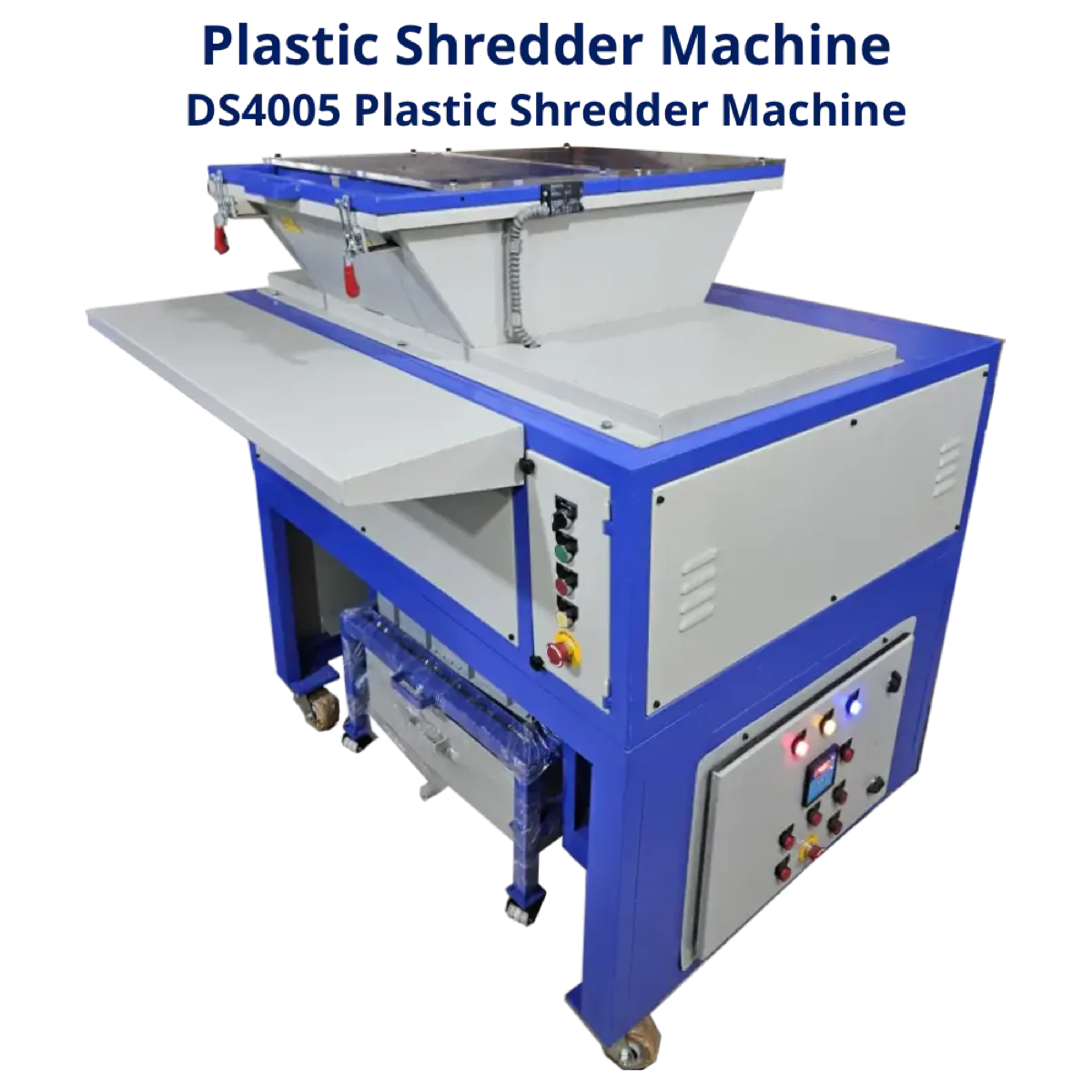
Raj Electricals builds both kinds of plastic shredder machine. The S3 single shaft range runs from 300–500 kg/hr on the S3-600 to 600–800 kg/hr on the S3-1000, and the dual shaft range has 13 models, from 250-350 kg/hr on the DS4005 to 2600-3000 kg/hr on the DS1080. Either can sit at the front of a line, ahead of a grinder, or work on its own where the job is to cut volume or destroy rejects.
Plastic grinding: how plastic granulators work
A grinder (granulator) is a rotor-and-knife machine. Knives on the rotor sweep past fixed knives in a scissor cut, again and again, and a screen below the rotor keeps material in the cutting chamber until it is small enough to fall through. That is why granulator output is even where shredder output is not, and why the screen decides the flake size.
A grinder needs material that fits its throat and is thin enough for its knives: bottles, jars, sprues, runners, thin-wall rejects and pieces that a shredder has already cut. Our RE series grinder machine for plastic comes in seven sizes, from the RE8 with an 8″ × 8″ throat and a 3 HP motor to the RE40 with a 40″ × 40″ throat and a 75 HP motor. Throughput runs from 35–45 kg/hr to 1,000–1,200 kg/hr on a 15 mm screen. The standard screen is 12–15 mm, with other sizes as per your requirement, and the CB models add a cyclone blower that conveys the regrind into bags.
The scrap grinder beside the machine
In a moulding or extrusion plant, a scrap grinder usually stands beside the machine and turns sprues, runners and rejects into regrind that goes straight back into the same process. A smaller RE grinder, such as the RE8 or RE12, is sized for this work. In a recycling plant, larger grinders take sorted bottles and shredded pieces and make flakes for washing or sale.
Which comes first: shredder or grinder?
Ask one question about your scrap: does it fit the grinder’s throat, and is it thin enough for the knives?
- Yes: grind it directly. Bottles, jars, sprues, runners and thin-wall rejects go straight into a grinder of the right throat size. A grinder alone often does the whole job.
- No: shred first, then grind. Bales, bags, film, drums, crates, purge lumps and FRP sheets go through a shredder first. The shredded pieces then feed the grinder, which makes the uniform flake. This pair is the standard line for bulky and mixed waste.
- Shred only. When the aim is to cut volume, or to destroy rejected and expired goods so that they cannot be reused, the shredder’s output can be the end product.
For rigid plastics, shredding plastic for recycling usually ends with grinding, because moulders and extruders need an even flake. Shredded film goes on to washing and an agglomerator instead.
Which machine for which plastic
How the work divides for the common streams. Each linked page covers its material in detail.
| Material as it arrives | First machine | Then | More on this material |
|---|---|---|---|
| PET bottles | Grinder, often with a cyclone blower | Washing, for post-consumer bottles | plastic bottle recycling machine |
| HDPE and LDPE bottles, cans, jerry cans | Grinder | Washing, for used containers | HDPE grinder machine |
| Sprues, runners, moulding rejects | Grinder beside the machine | Back into production | injection moulding scrap grinder |
| Purge lumps and start-up lumps | Single shaft shredder (S3-600) | Grinder | plastic lumps shredder |
| Crates and drums | Dual shaft shredder or S3-600 | Grinder | plastic crate shredder · plastic drum shredder |
| Carry bags and film | Dual shaft shredder | Washing and agglomerating | carry bag shredder |
| FRP sheets and panels | S3-600 or dual shaft shredder | Grinder | FRP shredder |
| ABS, PC and PA engineering plastics | S3 single shaft shredder | Grinder | ABS plastic shredder |
Who shreds and grinds plastic
The same two machines turn up in very different plants:
- Moulding, extrusion and blow moulding plants grind their own sprues, runners, flash and rejects, and shred purge lumps, so the material goes back into production instead of out as scrap.
- Recyclers and collection centres shred and grind collected bottles, bags, film, crates and drums into flakes they can wash, densify or sell.
- FMCG and pharma units shred expired, recalled and rejected goods so that they cannot be reused or resold.
- FRP fabricators shred offcuts and rejected sheets and panels.
If your plant makes scrap every day, the first question is whether it fits a grinder as it is. If it does not, it needs a shredder in front. Contact us with your material and volume for a recommendation and a quotation.
Shredder, grinder or both?
Tell us your material, its form as it arrives and your daily volume. Our technical team will recommend the machine for each stage.
Shredding and grinding FAQs
What is the difference between shredding and grinding plastic?
Shredding is the first cut: a slow, high-torque shaft, or a pair of them, tears or shears bulky, thick or flexible waste into coarse, uneven pieces. Grinding is the second cut: a faster rotor with knives cuts the material against fixed knives until it passes a screen, which gives uniform flakes. A shredder makes big things small, and a grinder makes small things even.
Is a crusher machine for plastic the same as a granulator?
Usually, yes. In India the words crusher, grinder and granulator all describe the same rotor-and-knife machine, with a screen that sets the output size. A shredder is a different machine, built for bulky and tough waste. Our plastic crusher machine range, the RE series, comes in seven sizes from 3 HP to 75 HP.
Do I need to shred plastic before grinding it?
Only if it is too big, too thick or too flexible for the grinder. Bottles, sprues, runners and thin-wall rejects go straight into a grinder of the right throat size. Bales, bags, film, drums, crates, purge lumps and FRP sheets need a shredder first, and the shredded pieces then feed the grinder.
What decides the size of plastic after grinding?
The screen under the rotor. Material stays in the cutting chamber until it is small enough to pass the screen, so the flakes come out below the screen size. On our RE grinders the standard screen is 12–15 mm, and other sizes are fitted as per your requirement. A shredder’s output is coarser: on the S3 single shaft range the screen is 40 mm on the S3-600 and 80 mm on the S3-1000.
Can plastic bags and film go straight into a grinder?
Loose bags and baled film are shredded first. In a fast grinder, light film tends to float above the knives and wrap around the rotor, while a dual shaft shredder grips it and pulls it through. Clean film offcuts can be ground in a grinder with a cyclone blower, such as the RE12CB. See our plastic film shredder page for the film line.
Get a Quote for a Shredder or Grinder
Tell us what you shred or grind, its form as it arrives, your daily volume and the output size you need. Our technical team will recommend the machine, or the shredder and grinder pair, and send a quotation.
Phone: +91 98700 12462
WhatsApp: Chat with our team
Email: rajelectricalsmumbai@gmail.com
Hours: 9:00 AM – 6:00 PM, all seven days
Continue exploring
Single vs Double Shaft Shredder
How the two shredder designs differ, and which suits your material. Learn more →
Plastic Recycling Plant Guide
The stages of a recycling line, the machines in each and what decides the cost. Learn more →
Grinders & Granulators
Seven RE grinder sizes, in base and cyclone blower models. Learn more →