Single Shaft vs Double Shaft Shredder: Which One Your Material Needs
Both are slow, high-torque shredders, and both turn big, tough waste into smaller pieces. They differ in how they cut, what they take in and what they give back. A single shaft shredder shears material against one rotor and suits thick, solid scrap. A double shaft shredder tears material between two shafts and suits bulky, hollow and flexible waste. Here is how each works, which materials suit each, and how to choose.
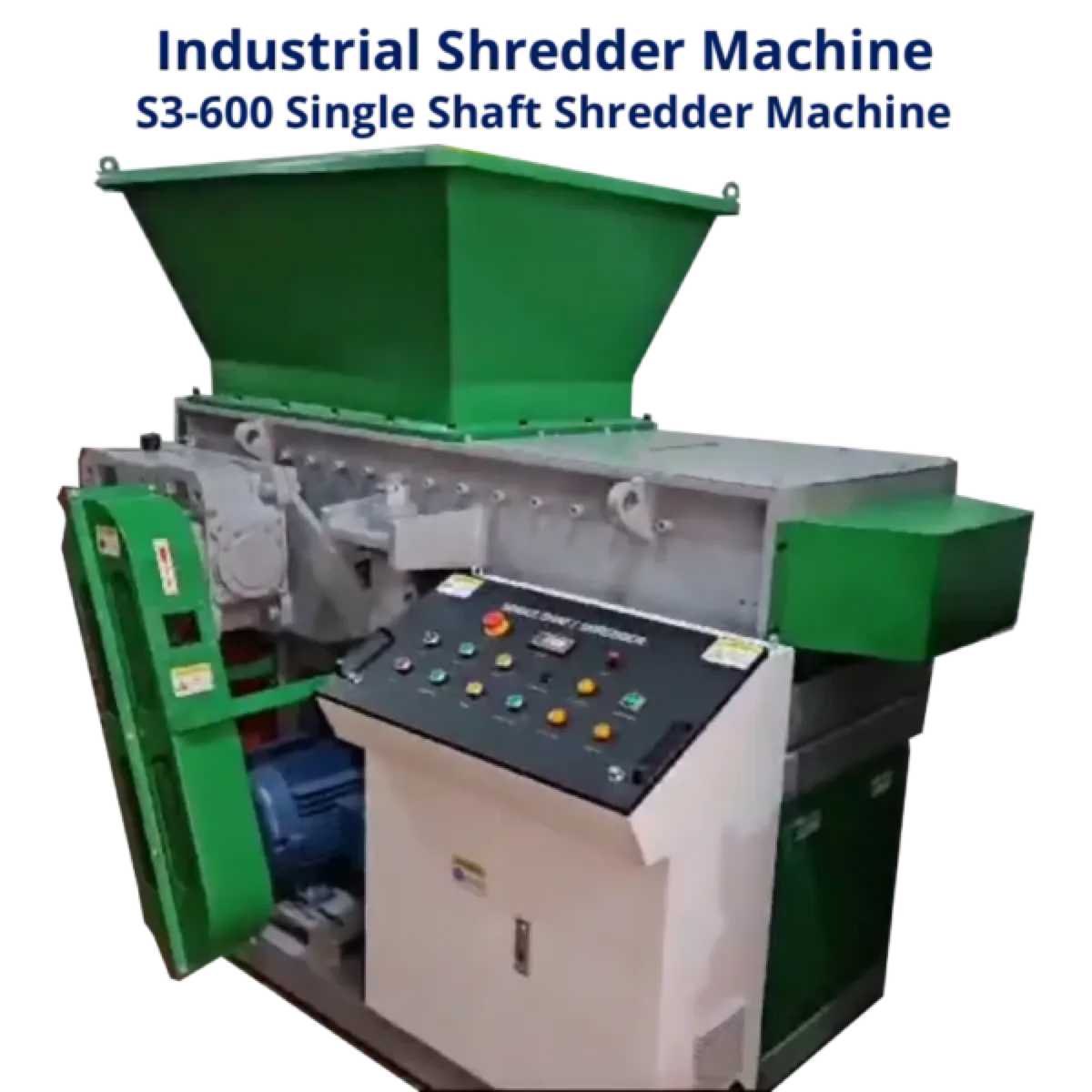
How a single shaft shredder works
A single shaft shredder has one rotor carrying many cutting blades, turning slowly against fixed blades in the cutting chamber. A hydraulic pusher presses the material onto the rotor, so a solid block is cut down pass by pass instead of riding on top of it. Where a screen is fitted below the rotor, pieces stay in the chamber until they are small enough to pass, which gives a more controlled output size.
Our single shaft shredder range, the S3 line, has three models. The rotor turns at 80 rpm on the S3-600 and at 60 rpm on the S3-800 and S3-1000, carrying 26, 33 or 42 rotary blades against 2 fixed blades. The S3-600 has a 40 mm screen and the S3-1000 an 80 mm perforated, interchangeable screen, while on the S3-800 a screen is not fitted as standard and is available as an optional accessory. The S3-600 has automatic start/stop and reverse sensing against overloading and jamming, and on the S3-800 and S3-1000 the hydraulic pusher self-regulates feed pressure.
How a double shaft shredder works
A double shaft shredder, also called a dual shaft or twin shaft shredder, has two parallel shafts fitted with interlocking cutters that turn towards each other at low speed. Material dropped into the hopper is gripped, pulled down between the shafts and torn apart. Because the cutters hook into the material, the machine usually needs no pusher, and it takes hollow, flexible and irregular items as they come: drums, crates, bottles, bags, woven sacks and film.
There is usually no screen, so the output is uneven strips and chunks rather than a sized piece. That suits volume reduction, the destruction of rejects, and a first stage ahead of a grinder.
Our double shaft shredder range has 13 models, from the DS4005 (5.0 HP, a 400 x 385 mm cutting head, 250-350 kg/hr) to the DS1080 (80.0 HP, a 1000 x 675 mm cutting head, 2600-3000 kg/hr). You choose the cutting head that takes your material as it arrives, then the drive and capacity that match your volume.
Single shaft vs double shaft shredder, side by side
| Single shaft shredder | Double shaft shredder | |
|---|---|---|
| How it cuts | One slow rotor shears material against fixed blades | Two slow, counter-rotating shafts grip and tear the material |
| Feeding | A hydraulic pusher presses material onto the rotor | Material drops from the hopper and the cutters pull it in |
| Output | More even pieces, set by the screen where one is fitted | Uneven strips and chunks, usually with no screen |
| Best for | Thick, solid, dense scrap: purge lumps, FRP boards, thick-walled parts, rigid engineering plastics | Bulky, hollow, flexible or mixed waste: drums, crates, bottles, bags, film |
| Typical role | First stage before a grinder, where an even piece matters | Volume reduction, destruction of rejects, first stage before a grinder |
| Our range | S3-600, S3-800 and S3-1000, from 300–500 kg/hr to 600–800 kg/hr | 13 DS models, from 250-350 kg/hr (DS4005) to 2600-3000 kg/hr (DS1080) |
Which materials suit each shredder
Single shaft: thick, solid and dense scrap
The S3-600 takes plastic, paper, fibre, organic waste and similar scrap through a 600 x 1000 mm side feeding hopper. In plastics, that means purge lumps and start-up lumps from injection and extrusion machines, FRP sheets, panels and boards, rotomoulding rejects, pipe trims and automobile plastics. Beyond plastics, it also takes wood, pallets and bulk paper. The S3-800 and S3-1000 are built for rigid plastic waste such as ABS, PC, PA and similar engineering plastics, through an 1800 x 1600 mm feed opening. Our plastic lumps shredder, FRP shredder and ABS plastic shredder pages cover these materials.
Double shaft: bulky, hollow, flexible and mixed waste
Our dual shaft machines take mixed plastic scrap, drums, crates, bottles, PP woven and non-woven bags, cartons, pharma rejects, e-waste and textile waste. Bags are a typical job: the DS5007 shreds plastic carry bags, PP woven cement bags, non-woven bags and jumbo bags. Our carry bag shredder, plastic crate shredder and plastic drum shredder pages cover these materials.
How to choose between a single shaft and a double shaft shredder
Four questions settle it, in this order:
- What is the material, as it arrives? A solid piece with no edge for two shafts to grip, such as a purge lump or a thick FRP board, belongs on a single shaft. Hollow, flexible or bulky waste, such as drums, crates, bags and film, belongs on a double shaft.
- What is the output for? If the shredded pieces feed a grinder or must be even, a single shaft shredder with a screen gives more control. If the aim is volume reduction or destruction, the uneven shred of a double shaft shredder is enough.
- How much, and for how long? Work from the kilograms you process each day and the hours you run. Capacity varies with the material, its bulk density and the feed rate, so size on your own material and leave headroom.
- Does your largest piece fit? The S3-600 has a 600 x 1000 mm side feeding hopper, and the S3-800 and S3-1000 an 1800 x 1600 mm feed opening. Our dual shaft cutting heads run from 400 x 385 mm on the DS4005 up to 1010 x 569 mm on the DS1040 and 1000 x 675 mm on the DS1080.
When a material could go either way, a trial on your own material decides it. Contact us with your material and volume, and our technical team will tell you which machine to try first.
After the shredder: grinding to regrind
Neither shredder makes granules. If you or your buyer need uniform regrind for moulding or extrusion, the shredded pieces go on to a grinder machine for plastic, where a screen fixes the flake size: 12–15 mm as standard on our RE series, with other sizes as per your requirement. Shredder then grinder is the standard pair for bulky and tough waste, and our guide to shredding plastic for recycling explains how the two stages divide the work.
Still between single and double shaft?
Tell us your material, its largest piece and your daily volume. Our technical team will recommend the shredder that fits, and the grinder after it if you need one.
Single shaft vs double shaft shredder FAQs
Which is better, a single shaft or a double shaft shredder?
Neither is better in general, because each suits different material. A single shaft shredder suits thick, solid, dense scrap and gives a more controlled piece size. A double shaft shredder suits bulky, hollow, flexible and mixed waste, and grips it without a pusher. Choose by your material, the output you need and your volume, and when a material could go either way, let a trial on your own material decide.
Is a twin shaft shredder the same as a double shaft shredder?
Yes. Twin shaft, two shaft, double shaft and dual shaft all describe the same design: two parallel shafts with interlocking cutters, turning towards each other at low speed. Our twin shaft shredder range has 13 models, from the DS4005 to the DS1080.
Which shredder gives a more uniform output?
A single shaft shredder with a screen, because pieces stay in the cutting chamber until they pass it. On our S3 range the S3-600 has a 40 mm screen and the S3-1000 an 80 mm perforated, interchangeable screen, and on the S3-800 the screen is an optional accessory. A double shaft shredder usually has no screen, so its output is uneven. For uniform granules, follow either shredder with a grinder.
Which shredder suits plastic bags, film and woven sacks?
A double shaft shredder, because its interlocking cutters grip flexible material and pull it between the shafts. Our DS5007 shreds plastic carry bags, PP woven cement bags, non-woven bags and jumbo bags. Baled or compacted film lumps that are too dense for a dual shaft machine can go on the S3-600 instead. See our plastic film shredder page.
Which shredder suits plastic lumps and purgings?
A single shaft shredder. A solid purge lump gives two shafts no edge to grip, while a hydraulic pusher holds it against a single rotor until it is cut down. The S3-600 takes lumps and purgings at 300–500 kg/hr (material-dependent) through its 600 x 1000 mm side feeding hopper, and an RE grinder can then turn the pieces into regrind. See our plastic lumps shredder page.
Get a Quote for a Single or Dual Shaft Shredder
Tell us what you shred, its form and largest piece, your daily volume and the output you need. Our technical team will recommend the S3 or DS model for your material and send a quotation.
Phone: +91 98700 12462
WhatsApp: Chat with our team
Email: rajelectricalsmumbai@gmail.com
Hours: 9:00 AM – 6:00 PM, all seven days
Continue exploring
Single Shaft Shredders
The S3 line: S3-600, S3-800 and S3-1000, with full specifications. Learn more →
Dual Shaft Shredders
Thirteen DS models, from the DS4005 to the DS1080. Learn more →
Shredding and Grinding Plastic
How shredders and granulators divide the work, and which comes first. Learn more →